
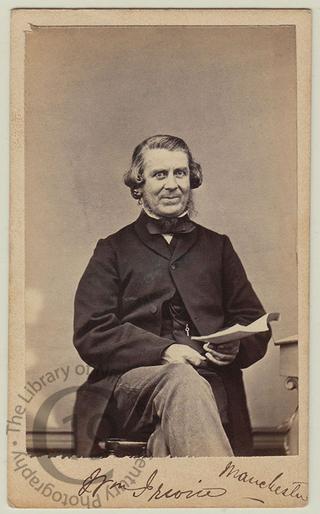
William Irwin
A carte-de-visite portrait of a sitter identified recto in the lower margin [possibly a signature] as 'Wm. Irwin [of] Manchester.'
Another inscription verso reads ‘William Irwin / Manchester / Died 5/5/78 aged 63.’
And along the lower edge: ‘See annual Monitor / 1879.’
Published each year between 1812 and 1919, the Annual Monitor was a collection of obituaries of prominent Quakers who had died the previous year; it includes well over 20,000 people. The volumes are available to read online via the ‘National Archive.’ William Irwin’s entry begins on page 102 of the volume published in 1879 and runs to four pages.
‘W.I. joined the Society of Friends when about twenty-two years of age. […] Before this change took place in his religious views, he had belonged to a congregation of Independents in his native town of Wigton, and was strong attached to their ministry […] 1815
‘Giving heed to the manifestations of Divine guidance, he was led step by step to take up the cross and adopt the testimonies as well as the doctrines of Friends, in plains of language, behaviour, and dress, in his outward walk among men; his endeavour being to walk consistently with the religion he professed. Through the remainder of his life he was conspicuous for his straightforward and unflinching zeal […] This frequently led him into controversy with such as he believed to come short of the profession they made as members of the same Society, which caused him many conflicts and much sorrow of heart. […] he strove to warn and persuade all such to consider their ways and doings.
‘[…] William Irwin, in transacting his outward business as a printer, maintained the same strictness of principle, refusing to execute such orders as he felt would comprising his testimony as a Friend. Marked was his open avowal of his sentiments on these occasions, as he pleaded with those who wished for his services to suppress such writings as would be likely to bring sorrow to themselves and injure others.
‘[On 5 May 1878], he left home in the morning to attend Liverpool meeting, where he was engaged in close testimony. On returning home on the evening by rail, he left the train about four miles from his own residence, intending to walk the distance. While walking, he fell, and before medical help could be procured, he breathed his last, leaving behind him this testimony, “that he had served God in his day and generation.” It came upon his numerous relatives and friends with almost overwhelming effect, through the suddenness of their loss.’
The photographer is identified by a backplate incorporating the legend ‘Light and Truth,’ a motto sometimes used by Quakers. Searching on eBay, there is at this moment [August 2026] a carte-de-visite listed with the same backplate, and recto in the lower margin the photographer’s name, Joseph B. Forster of Hale near Altrincham (which is 8 miles SW of Manchester)
Code: 128214


