
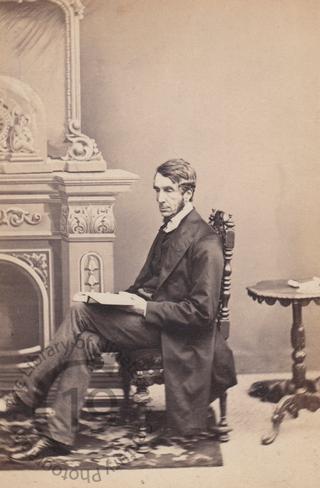
Professor John Selwyn
A carte-de-visite portrait of the Anglican clergyman and amateur astronomer the Reverend William Selwyn.
Born on 19 February 1806, Selwyn was the eldest surviving son of the lawyer and legal writer William Selwyn (1775-1855). He was educated at Eton and at St John’s College, Cambridge (BA 1828, MA 1831, BD 1850, DD 1864.) He was ordained a deacon in 1829 and became a priest in 1831. He was appointed Rector of Branston in Leicestershire in 1831; in 1846 he became the Vicar of Melbourne in Cambridgeshire. From 1829 to 1832 he was a Fellow of St John’s. From 1833 to 1875 he was a Canon Residentiary of Ely; from 1855 to his death in 1875 he was Lady Margaret’s Professor of Divinity, the oldest professorship at Cambridge. He was appointed a Chaplain in Ordinary to the Queen in 1859. In 1872 he became Honorary Joint Curator of the Library of Lambeth Palace.
Whilst at Ely he established an observatory in the cathedral precincts. In collaboration with John Allan Pershouse Titerton, a local photographer and artist, he prepared a series of photographs of the solar disc over an entire sunspot cycle between 1863 and 1874 using a six-inch achromatic lens. From 1866 onwards he was seriously ill and this, together with his ecclesiastical commitments, prevented his work from being published. The prints were instead donated to the Royal Greenwich Observatory and Selwyn was elected a Fellow of the Royal Society in 1866. He was also elected a Fellow of the Royal Astronomical Society.
He died, aged 69, on 24 April 1875 at Vine Cottage, Cambridge, as a result of a fall from his horse. There is a white marble effigy on his tomb in Ely Cathedral. He was survived by his wife, Juliana Elizabeth née Cooke, whom he had married in 1832. He left an estate valued at £60,000.
His younger brother was George Augustus Selwyn (1809-1878), the first Anglican bishop of New Zealand.
Photographed by McLean, Melhuish and Haes of Haymarket, London.
Code: 128175


