
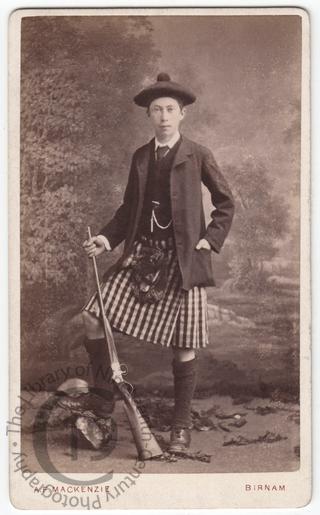
Ernest Wright Alexander, V.C.
An inked inscription in a period hand on the back of the mount identifies the sitter as ‘Ernest Alexander / Sept. 1879 / Aged 10.’
Born in Liverpool on 2 October 1870, Ernest Wright Alexander was the son of Robert Alexander, a ship owner and director of the Suez Canal , and his wife Annie née Gregg. Following his education at Harrow, he went to the Royal Military Academy at Sandhurst. In 1889 he joined the Army as a Second Lieutenant in the Royal Field Artillery and was stationed in India. By 1899 he had reached the rank of Captain and in 1900 he returned to England.
On 1 September 1903 ‘at Aldershot Parish Church, Captain Ernest Wright Alexander, Royal Field Artillery [married] Rose, only daughter of the late Major H.G. Newcomer, R.A., and Mrs Newcombe of Aldershot Manor’ (Reading Mercury, 5 September 1903).
He served a second tour of India 1903-1906 and was promoted to the rank of Major in the latter year. The military history J.M. Bourne describes his military career up to this point as ‘unspectacular.’
When the First World War started, he was stationed in Belgium, taking part in the Great Retreat from Mons in August 1914. It was for his gallantry and devotion to duty during the action at Elouges on 24 August 1914 that he received the Victoria Cross, the third to be awarded during the war (two had been awarded the day before).
He continued to serve for the rest of the war, eventually rising to the rank of Major-General in April 1916. In all he was mentioned nine times in despatches. He also received the Military Cross of Savoy (Cavalier) and the Croix de Guerre.
Major-General Ernest Wright Alexander died, aged 63, at Horswell House, South Milton in Devon on 25 August 1934 and was buried in Putney Vale Cemetery. His medals are on display at the Imperial War Museum in London.
Photographed by A.F. Mackenzie of Birnam, Perthshire.
Code: 128039


